5 Reasons the T-72 Tank in WARDOGS Feels Impossible to Kill and What Actually Counters It
Want articles like this for your own video to promote it on YouTube and Google? Order them through the Telegram bot @sat_sit_bot. Articles with your video embedded are written and posted by the bot itself — on popular topical sites (no ads). Free trial — 50 articles.
· based on the channel Josephant
Key takeaways
- The T-72 is a late-unlock vehicle in WARDOGS that becomes available after the match reaches a set team-point threshold, the same kind of gate that limits armed helicopters.
- RPG hits register inconsistent damage: players report that near misses can hurt the tank more than direct impacts, and that the RPG underperforms against the tank compared with lighter vehicles.
- C4 planted by a dismounted player is the most reliable close-range answer, but it requires reaching the hull without being spotted by the tank's third-person camera.
- Grenade splash can chip a tank thanks to simplified damage modeling, which is why thrown explosives sometimes work where rockets fail.
- The T-72 has no respawn pool of its own: losing it costs the crew the vehicle for the rest of the match, unlike infantry who keep coming back.
The T-72 in WARDOGS is not unkillable — it is a late-unlock vehicle with a narrow set of real counters, and most players attack it with the wrong tools. RPGs fired from the front, grenades thrown at the hull and lone rushes at a tank that can see 360 degrees all fail for predictable reasons. What works is C4 placed on the hull, flanking shots at the rear and sides, and coordinated pressure from several directions while the crew is distracted.
Why the T-72 in WARDOGS feels overpowered to most players
The T-72 combines three advantages that are hard to beat in public matches: heavy armor, a third-person camera that spots infantry before they see the tank, and a main gun that deletes anything it hits. A single crew can farm a whole capture point because most players bring no anti-tank tool at all, and the ones who do often fire from the worst possible angle. The tank also arrives at a point in the match when infantry have already spent their explosives on other fights, so the first encounter with it is usually a one-sided one.
The 5 counters that actually work against the T-72
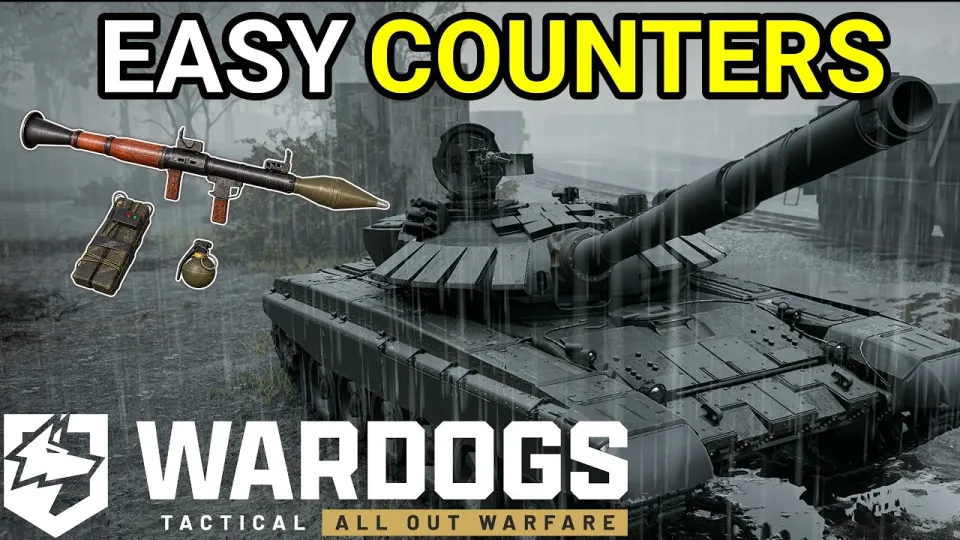
- C4 on the hull. A dismounted player who reaches the tank unseen can plant C4 and destroy it outright. This is the most consistent answer and the reason tank crews fear infantry that break line of sight.
- Rear and side RPG shots. Armor is modeled directionally, so rockets into the back and flanks do far more than frontal hits. Standing in front of a T-72 with an RPG is the single most common mistake.
- Grenade splash. Simplified damage lets fragmentation damage the hull even though a real 80 mm plate plus additional armor would shrug it off. Throwing from cover at longer range often beats a risky rocket shot.
- Attack helicopters. Armed helicopters are gated behind the same kind of team-point threshold as heavy vehicles, and once they are up they are the hardest counter to a tank in the open.
- Two or more attackers at once. A tank can only point its gun and its attention in one direction. One player baiting from the front while another plants C4 or fires from the rear converts most tank fights.
Why RPG hits feel broken against the T-72
Damage registration against the T-72 is the most complained-about part of the vehicle, and the complaints are specific: rockets that miss the hull sometimes deal more damage than rockets that connect. That points to splash and hitbox behavior rather than a raw health value, and it means players cannot trust a clean hit to be rewarded. The practical takeaway is to aim for the rear and tracks, fire from a stable position, and treat every rocket as a gamble rather than a guaranteed kill. Against lighter vehicles like the Humvee the same launcher behaves far more consistently, which is exactly why the inconsistency stands out.
Third-person view and the stealth problem
The T-72 sees more than its crew should. The third-person camera lets a driver scan over walls and around corners, so infantry who creep along cover are often spotted before they can see the tank themselves. Once spotted, a tank usually reverses out of danger faster than a player on foot can close the distance, which is why chases rarely end well. The counter is patience: let the tank roll past, attack from the direction it just left, and use buildings and terrain that block the camera rather than just the hull. Sound also gives the tank away at long range, so tracking it before engaging is easy — the hard part is staying unseen.
Unlock timing and progression complaints
A large share of the frustration is not about armor values at all but about when the T-72 appears. Players argue that tanks, heavy artillery and attack helicopters should all sit behind the same team-point threshold, so that infantry have their own anti-tank options unlocked by the time armor rolls out. There is also a progression angle: crews who leveled driver skills early gained a large advantage over players who had nothing to answer them with. On the other side of the argument, tank crews point out that infantry respawn indefinitely while a destroyed tank is gone for the rest of the match — a single mistake ends their game.
What tank crews and infantry both get wrong
Tank crews die when they push alone into built-up areas without infantry screening them, exactly as real doctrine warns. A tank without support has blind spots that a single C4 carrier can exploit. Infantry lose when they trickle in one at a time, fire from the front, or ignore the tank entirely and let it hold a point. The healthy pattern is a tank paired with a couple of players watching the flanks, and infantry answering with two or three attackers working opposite angles. In public matches that coordination is rare, which is why the T-72 keeps looking stronger than its numbers suggest.
Summary
The T-72 is not invincible in WARDOGS, but it is unforgiving: it punishes frontal rockets, solo pushes and players who bring no anti-tank gear, and it rewards crews that keep infantry support and watch their flanks. C4, rear and side shots, grenade splash, attack helicopters and multi-angle pressure are the counters that consistently work. The debate over whether it is overpowered comes down to unlock timing and damage consistency more than raw armor. Josephant breaks down the same questions in the video above, including where RPG, C4 and grenade attempts usually go wrong.
Source: Why Everyone Hates the T-72 Tank in WARDOGS · Markdown version
Questions & answers
Is the T-72 tank in WARDOGS actually overpowered?
It is strong but not unkillable. The T-72 has heavy frontal armor and a third-person camera that spots infantry early, yet C4 on the hull, rear and side rockets and attack helicopters all destroy it. Most of the frustration comes from unlock timing and inconsistent RPG damage rather than from armor values alone.
Why does my RPG do less damage when it hits the tank?
Damage against the T-72 is directional and includes splash, so rockets that land near the hull can register more than clean frontal hits. Aim for the rear and sides, fire from a stable position, and expect a single rocket to rarely be enough.
How do I sneak up on a T-72 without being seen?
Use cover that blocks the crew's third-person camera, not just the hull, and approach from the direction the tank just left. Wait for it to pass, listen for its engine to track it, and only move when it is firing or turning away. Grenades thrown from a distance are safer than a close approach.
When should tanks become available in WARDOGS?
Many players argue tanks, heavy artillery and armed helicopters should all unlock at the same team-point threshold, so infantry have anti-tank options ready when armor appears. Others note that a destroyed tank is lost for the whole match while infantry respawn, which already balances the vehicle.